
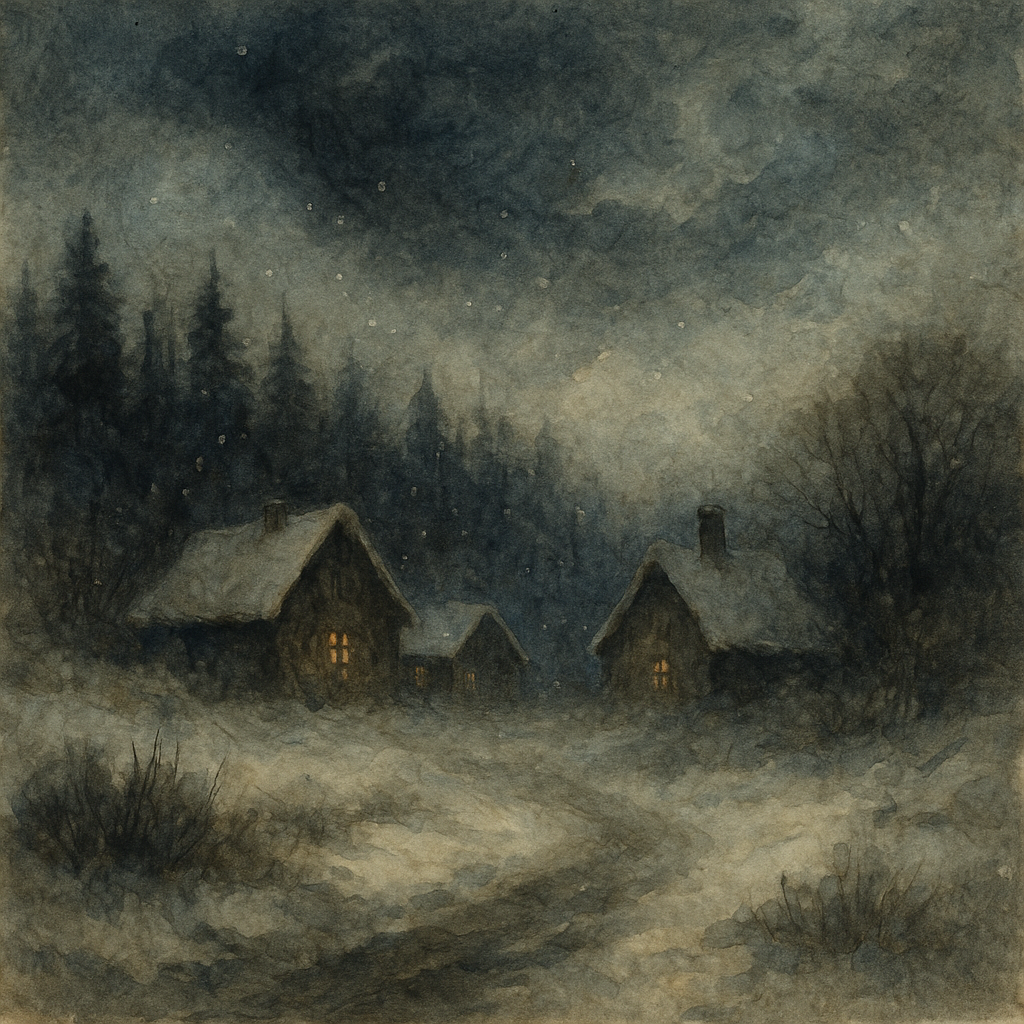
In older European folklore, winter was ruled by terrifying creatures—horned demons, child-stealing witches, ghostly animals, and ancient goddesses who punished the lazy or the wicked. These dark Christmas legends shaped the season long before modern traditions softened their edges.
From Krampus and Perchta to the Mari Lwyd and Iceland’s Yule Cat, these winter monsters reveal the shadowy origins of Christmas as it was once celebrated across Europe.
Here are some terrifying Christmas creatures from European folklore. Light up your candle and follow me.
1. Krampus – Alpine Region (Austria)

Long before Christmas was soft and sentimental, the Alps had Krampus — a horned, fur-covered monster who followed Saint Nicholas through the snow. While the saint rewarded children with sweets, Krampus carried chains, birch rods, and a basket on his back. The good were blessed; the wicked were whipped, chased through the streets, or carried off entirely.
But that version is newer. In older Alpine folklore, Krampus didn’t belong to a saint at all. He walked with the winter goddesses — Perchta in Austria and Bavaria, and Frau Holle in Germany — as one of the wild spirits who ruled the dark season long before Christmas existed. Some scholars connect him to ancient midwinter punishment rites and even the Wild Hunt.
You must know this one already because, who doesn’t, am I right? This guy is the star among all creepy Christmas creatures, but always worth mentioning.
Either way, December 5th — Krampusnacht — is a reminder that Christmas once had claws.
2. Perchta – Alpine Region (Austria, Bavaria, South Tyrol)

During the Twelve Nights of Christmas, Perchta roams the winter mountains. She can appear as a shining maiden dressed in white… or as a hag with an iron nose and a knife hidden beneath her skirts. Perchta checks whether the household’s winter spinning is finished. Industrious girls are rewarded with small gifts. The lazy suffer a far worse fate: she cuts open their bellies and replaces their innards with straw and stones.
Her entourage — the Perchten — wear grotesque wooden masks and rattling bells, storming through Alpine villages in carnivals of chaos and fear. But this is only the later folklore. In older tradition, Perchta is a winter goddess — a judge of order, protector of women and children, and guardian of the souls of the dead. She ruled the dark season long before Christmas existed.
Many scholars see her as the same ancient figure as Frau Holle, another winter goddess softened into fairytale by the Brothers Grimm. But the masked shrieking Perchten keep her true nature alive: winter once belonged to her. And those who forgot their duties paid the price.
3. Grýla – Iceland

Most people know Grýla as the giantess who eats misbehaving children at Christmas. But Grýla is far older than the holiday itself. She appears in medieval Icelandic texts as a mountain-dwelling troll, a mother of monsters, and a bringer of famine. When the winter hunger came, it was said Grýla was on the move. Children who disobeyed their parents risked being thrown into her cauldron.
Only later was she added to Christmas, alongside her thirteen chaotic sons — the Yule Lads — and her monstrous companion, the Yule Cat.
In older belief, Grýla is not simply “a Christmas witch.” She is winter’s hunger given a face.
4. The Yule Cat – Iceland
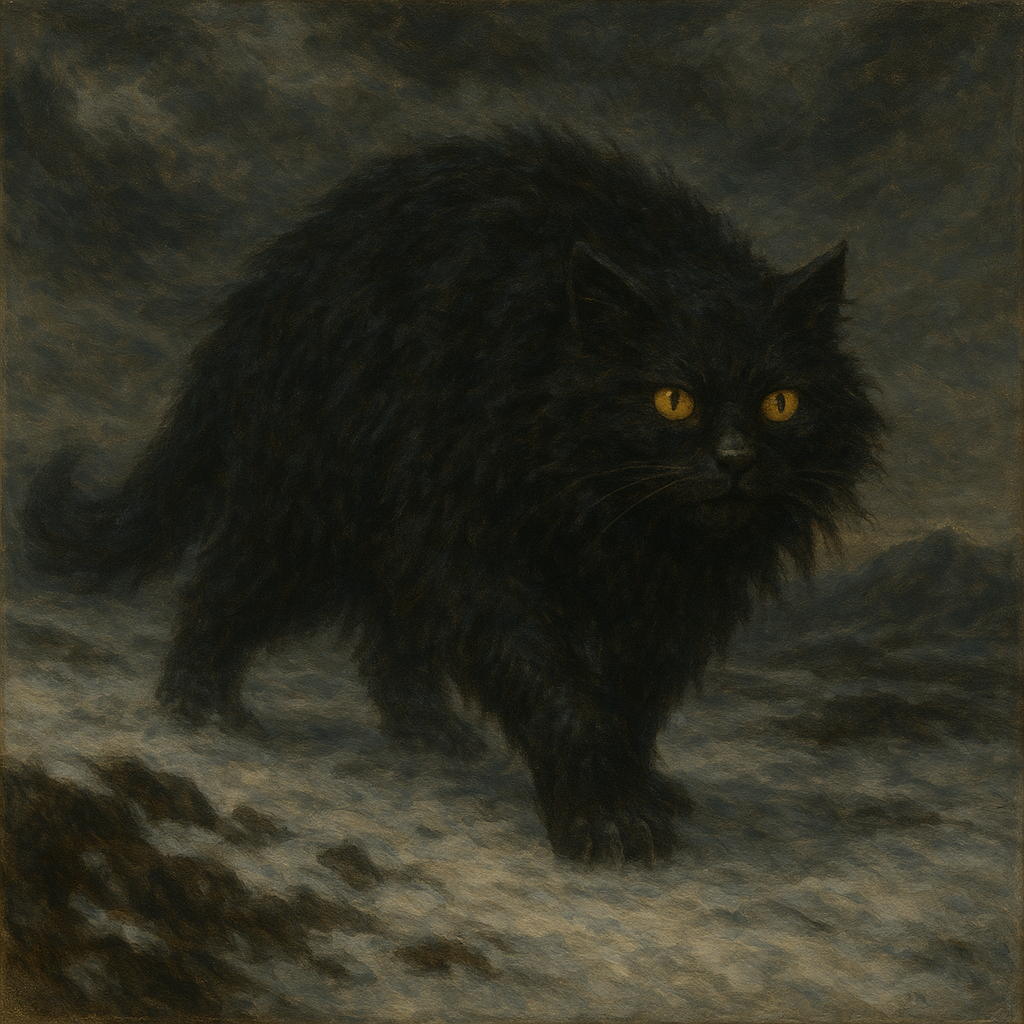
Today, the Yule Cat is usually described as a giant Christmas monster that eats anyone who doesn’t receive new clothes for the holiday, like is the first ever officer of the fashion police. Parents still tell children to finish their chores… or else.
But the older tradition is deeper: the Yule Cat belonged to Grýla and her household of trolls, stalking the snow during the winter wool work. Those who hadn’t earned new clothing — meaning they hadn’t contributed to the winter labor — were fair game.
It was a tale about survival in the harsh Icelandic winter:
no work, no warmth, no mercy.
The cat’s glowing eyes and enormous size are folkloric details, not invention. And like Grýla, the Yule Cat predates cozy Christmas. It was born from a time when failing to prepare for winter could kill you.
I still like calling it the first officer of the fashion police though.
5. Kallikantzaroi – Greece
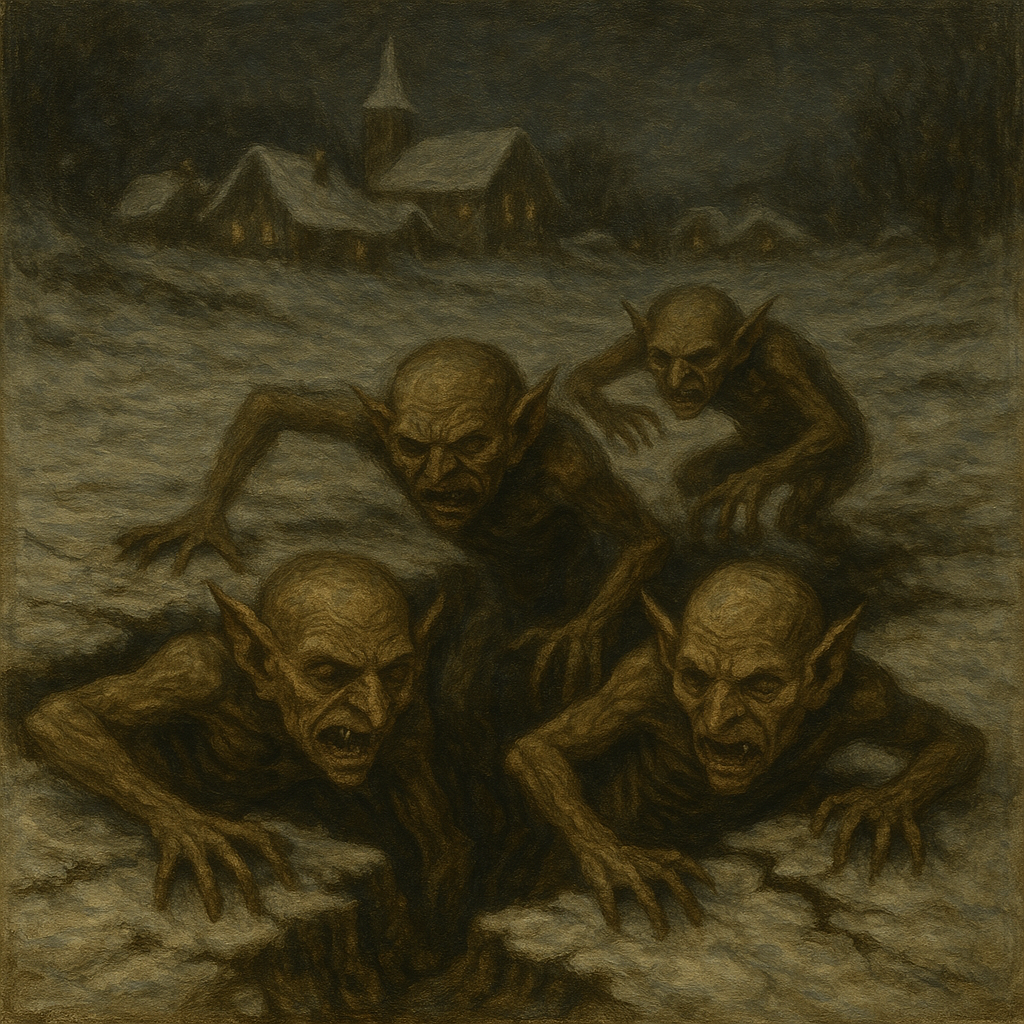
Today the Kallikantzaroi are known as mischievous goblins who appear between Christmas and Epiphany, sneaking into homes to spoil food, steal sausages, or terrify sleepers. Holy water drives them back underground on January 6th.
But their deeper story is older and far stranger. In some regions, the Kallikantzaroi spend the entire year beneath the earth, chewing at the World Tree or cosmic pillar that holds the world together. When Christmas comes, the world is so busy with prayers and blessings that the demons abandon their task and rise to cause chaos among humans.
When they return, the tree has healed — and they must start again.
A dark joke at humanity’s expense: winter brings a fragile truce.
6. The Straggele – Tyrol, Austria

Most modern descriptions treat the Straggele as Alpine bogeymen: fur-clad figures with grotesque masks who chase people through the streets during winter festivals. They rattle chains, swing switches, and burst into homes and taverns uninvited.
Older folk belief gives them deeper roots.
The Straggele are winter spirits connected to the Wild Hunt and the unquiet dead — souls who roam the mountains when the veil is thinnest. Their masked processions are not random violence, but ritual: a controlled moment of chaos before the year is reborn.
Like Perchta’s Perchten, they are a reminder that the Alps once let winter roar instead of pretending it was gentle.
7. Frau Holle – Germany

Frau Holle is best known today as a winter spirit who punishes laziness and rewards hard work. In her realm it snows when she shakes out her feather beds, and her judgment is exact: industrious girls are showered with gold, the idle are drenched in pitch that never washes away. This is the version softened by the Brothers Grimm.
The older belief is far darker. Long before she became a nursery tale, Frau Holle was a winter goddess — a guardian of the dead, a protector of women and children, and a psychopomp who led souls into the underworld. Some scholars see her as the same ancient being as Perchta, split only by geography. Others connect her to pre-Christian mother goddesses who ruled the dark season.
In folk tradition, Holle is winter itself: cold, fair, and merciless. Her stories, like Perchta’s, remind us that midwinter was once a time of reckoning — not sentiment.
8. Mari Lwyd (Wales)
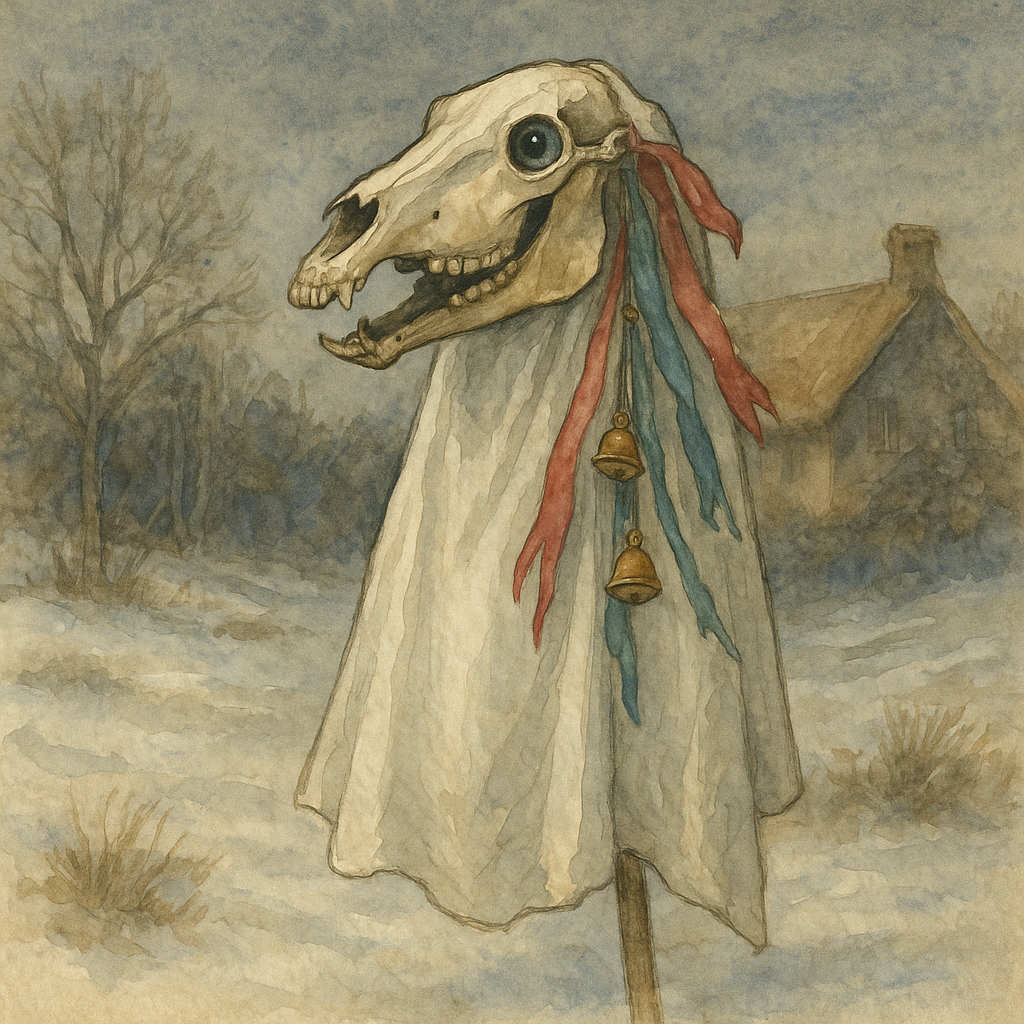
Winter in Wales once carried a knock at the door that blurred the line between festivity and the supernatural. Imagine opening your home on a dark midwinter night to see a horse’s skull—with glassy eyes, snapping jaw, and ribbons fluttering in the wind—standing on your doorstep. Draped in a white sheet and carried by a hidden figure beneath, this was the Mari Lwyd, a ghostly visitor who traveled house to house demanding entry.
The Mari Lwyd’s arrival was a verbal battle: the household and the skull-bearer exchanged improvised rhyming insults and clever verses. If the Mari Lwyd “won,” the skeletal horse earned the right to enter, raid the pantry, and drink the household out of ale.
Scholars link the custom to ancient midwinter rites of the dead and “hooded animal” traditions found across the British Isles. While not a monster in the modern sense, the Mari Lwyd’s hollow eye sockets and ivory teeth make it one of the eeriest winter visitors in European folklore—festive, yes, but undeniably unsettling, as though a spirit stepped out of the graveyard for one last celebration.
9 Hans Trapp (France – Alsace / Germany)

If Krampus is terrifying, Hans Trapp may be worse. In the folklore of Alsace and parts of Germany, Hans Trapp was once a wealthy nobleman who practiced black magic and made a pact with the Devil. For his crimes, he was excommunicated by the Church, driven from society, and struck dead by lightning. But death didn’t end his story.
Hans Trapp returned as a scarecrow-like figure—tattered clothes stuffed with straw, face twisted and wild—wandering the countryside in winter, hunting for children to eat. In some traditions he accompanies Saint Nicholas, the dark counterpart to generosity and forgiveness. While the saint brings sweets and gifts, Hans Trapp brings terror. Children who disobey, lie, or are lazy risk being thrown into his sack and devoured.
Folklorists see echoes of older agricultural and winter-punishment rites beneath the Christian surface, but regardless of origin, the tale remains chilling. In Alsace, Christmas was never just lights and angels—it came with a scarecrow-demon stalking the snow.
The end. For now.
I know Christmas is supposed to be this positive time, full of light and hopes and dreams… and I don’t know about you, but these little dark corners of imagination — these creatures of folklore, the gothic tales of my favorite vampires, the ghost stories — all these eerie, wonderful things are what make my holiday time special.
The hope that somewhere, in another realm, there is room for wonders.
Have a beautiful time.
I hope you enjoyed the post. Come back! And follow Caipora Books on YouTube and social media.
Love,
Ariane



 English
  German